

Bio: Nitheesh is the founder of MentorCrux, an India-based mentorship platform for core engineers. His mission is to create a space where expert knowledge is accessible to all, providing the tools and insights necessary for professional growth in the core engineering sector.
You spent four years memorizing Maxwell’s equations, calculating transmission line losses on paper, and writing lab records. Yet, when you look at core job postings for hardware design, power electronics, or EV powertrain integration, the requirements look like a foreign language.
You don’t need another online video course. You don’t need to collect more certificates. What you need is an industry compass.
When I graduated, I faced the exact same wall. The college placement cell pointed everyone toward IT services mass recruiters, whispering that core engineering is dead in India. It’s a lie. Core engineering isn’t dead, but the traditional bridge from campus to the core industry is broken. To cross it, you need someone who is already on the other side.
In this guide, I will break down exactly how to find an electrical engineering mentor, navigate your career paths after electrical engineering, and transition from raw theory to hands on industry relevance.
The Core Dilemma: Electrical Engineering Career Confusion
Most electrical engineering career confusion starts from a fundamental disconnect: academia rewards you for knowing why a circuit works theoretically, while the industry pays you for knowing how to make it work reliably under constraints like cost, thermal limits, and electromagnetic interference (EMI).
Without proper electrical engineer career guidance, freshers typically fall into three dangerous traps:
- The IT Escape Hatch: Out of sheer frustration, taking a software testing or coding job that has nothing to do with your passion for hardware, power systems, or electronics.
- The Tutorial Hell Loop: Spending thousands of rupees collecting generic video course certificates that recruiters completely ignore because there is zero proof of hands-on skill.
- The Infinite Site-Job Grind: Accepting a low paying maintenance or construction site role with no upward mobility, simply because you didn’t know how to break into a high-end design environment.
A dedicated career mentor for core engineers changes this entire trajectory. They don’t teach you textbook formulas; they show you how real world engineers use those formulas to build scalable physical products.
Why Online Mock Interviews and generic platforms fail EEE freshers
If you are preparing for a major public sector undertaking or a corporate technical round, a generic resume reviewer or HR mock interviewer cannot save you.
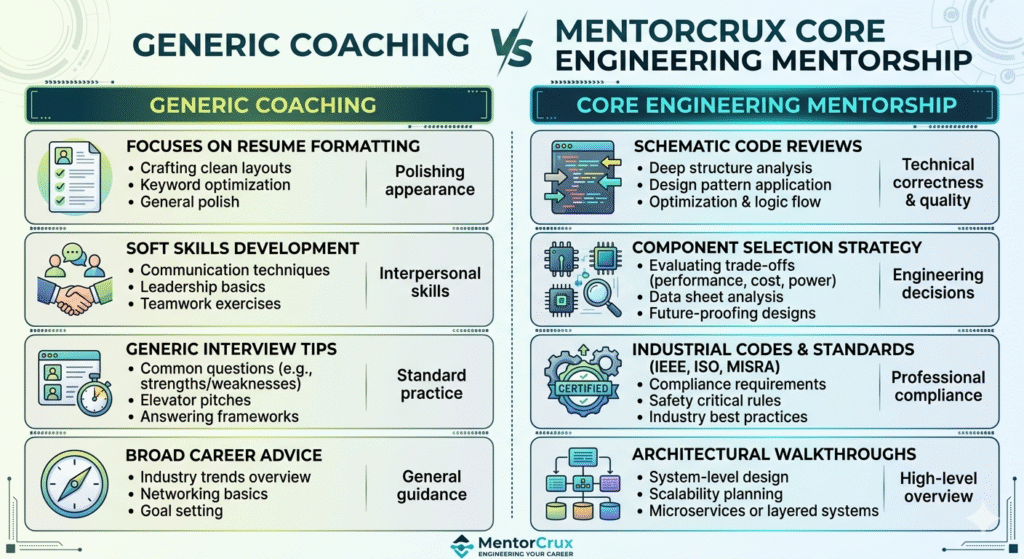
Consider a typical scenario: you have an upcoming mock interview for L&T or a PSU interview preparation for EEE freshers window. A standard career coach can tell you to stand straight and speak clearly. But they cannot critique your understanding of busbar sizing, protection relay coordination, or why you selected a specific MOSFET over an IGBT in your minor project.
Step-by-Step: How to Identify and Connect with an Electrical Engineering Mentor India
Finding an elite mentor requires moving beyond casual networking. You need someone who actively works in your target domain, whether that is VLSI, embedded firmware, industrial automation, or renewable energy systems.
1. Define Your Target Domain First
Before seeking electrical engineering career guidance for freshers, you must isolate the specific sub-vertical you want to conquer. Do you want to work on large-scale infrastructure (Switchgear, Substation design, HVAC systems) or high-speed hardware design (PCB layout, Signal Integrity, Microcontrollers)?
2. Auditing for Practical Skill Gaps
Once you select a path, a quality mentor will evaluate your baseline using an electrical design engineer software skills checklist. They will map your current abilities against industrial expectations:
| Engineering Sub-Domain | Baseline Academic Theory | Missing Industrial/Software Skill |
| Power & Utilities | Symmetrical Components, Fault Analysis | ETAP (Electrical Transient Analyzer Program), Single Line Diagram (SLD) creation |
| Hardware & Electronics | Basic Circuit Theorems, Op-Amp theory | Altium Designer, KiCad, High-Speed Routing, EMI/EMC mitigation |
| Electric Vehicles (EV) | DC Motor Characteristics, Battery chemistry | MATLAB/Simulink modeling, Battery Management System (BMS) logic development |
| Industrial Automation | Logic Gates, Basic Boolean Algebra | PLC/SCADA programming (Siemens TIA Portal, Rockwell), Control Panel Design |
3. Move from Cold Pitching to Value-First Engagement
If you reach out to a senior engineering manager on LinkedIn with a generic “Sir, please find me a job” message, you will be ignored. High-value industry professionals respond to specific, technical curiosity.
Instead, ask for a hyper-focused micro-review of a project you are building. For example:
“I am working on an isolated flyback converter layout using a UCC28740 controller, and I am struggling with minimizing the leakage inductance loop to control voltage spikes. Could you look at this schematic snippet for 2 minutes?”
This demonstrates that you possess hand-on intent, making an online mentorship for engineers arrangement highly likely to succeed.
The Roadmap: Moving from Field/Site Engineer to Design Engineer Roles
A major pain point we solve daily at MentorCrux involves the site engineer to design engineer roadmap. Hundreds of EEE freshers accept execution or maintenance roles at industrial sites, only to realize the hours are grueling and the skill ceiling is low.
If you are currently a site engineer wanting to move into design, your strategy must pivot entirely to portfolio creation.
How to use your site experience to power your design resume:
- Reverse-Engineer Your Site Equipment: Don’t just check the maintenance log of a VFD (Variable Frequency Drive) or transformer at your site. Source its technical manual. Study its wiring diagrams, protection metrics, and cooling constraints.
- Translate Field Problems into Design Solutions: If a specific motor controller repeatedly fails at your plant due to voltage sags, simulate that exact power quality issue in MATLAB. Propose an active filtering solution.
- Document the Process: Build this case study into an engineering portfolio. When you present this portfolio during a job application, you immediately stand out from candidates who only have academic theoretical knowledge.
Pro-Tips: How to Crack L&T/Tata Projects Interviews
Having analyzed dozens of successful recruitment runs through our platform, I can tell you that cracking premium core technical interviews requires a specific mental framework. Here are the unwritten rules for clearing technical panels at companies like Larsen & Toubro, Tata Power, or major PSUs:
- They Don’t Test Memorization, They Test Diagnostics: An interviewer will rarely ask you to define a synchronous motor. Instead, they will present a scenario: “Your multi-megawatt motor is overheating under 80% load, but the cooling fan is functional. What are your first three troubleshooting checkpoints?”
- Know Your Codes and Standards: Textbook problems ignore regulatory compliance. Real engineering runs on standards. If you are discussing cable sizing or transformer installation, knowing relevant IS (Indian Standards) or IEC/IEEE codes instantly establishes your industry maturity.
- Be Ready to Draw: In almost every face-to-face or virtual technical round, you will be handed a pen and paper or a digital whiteboard. You will be asked to draw a Single Line Diagram (SLD), an H-bridge inverter circuit, or a control logic ladder diagram on the fly. Practice clean, structured drafting.
The MentorCrux Edge: A Mentor’s Perspective
Let’s cut through the noise. The difference between an average engineer making 3 LPA on a construction site and an elite design engineer building cutting-edge EV systems or grid architectures at 12+ LPA isn’t their college GPA. It is their access to specialized industry wisdom.
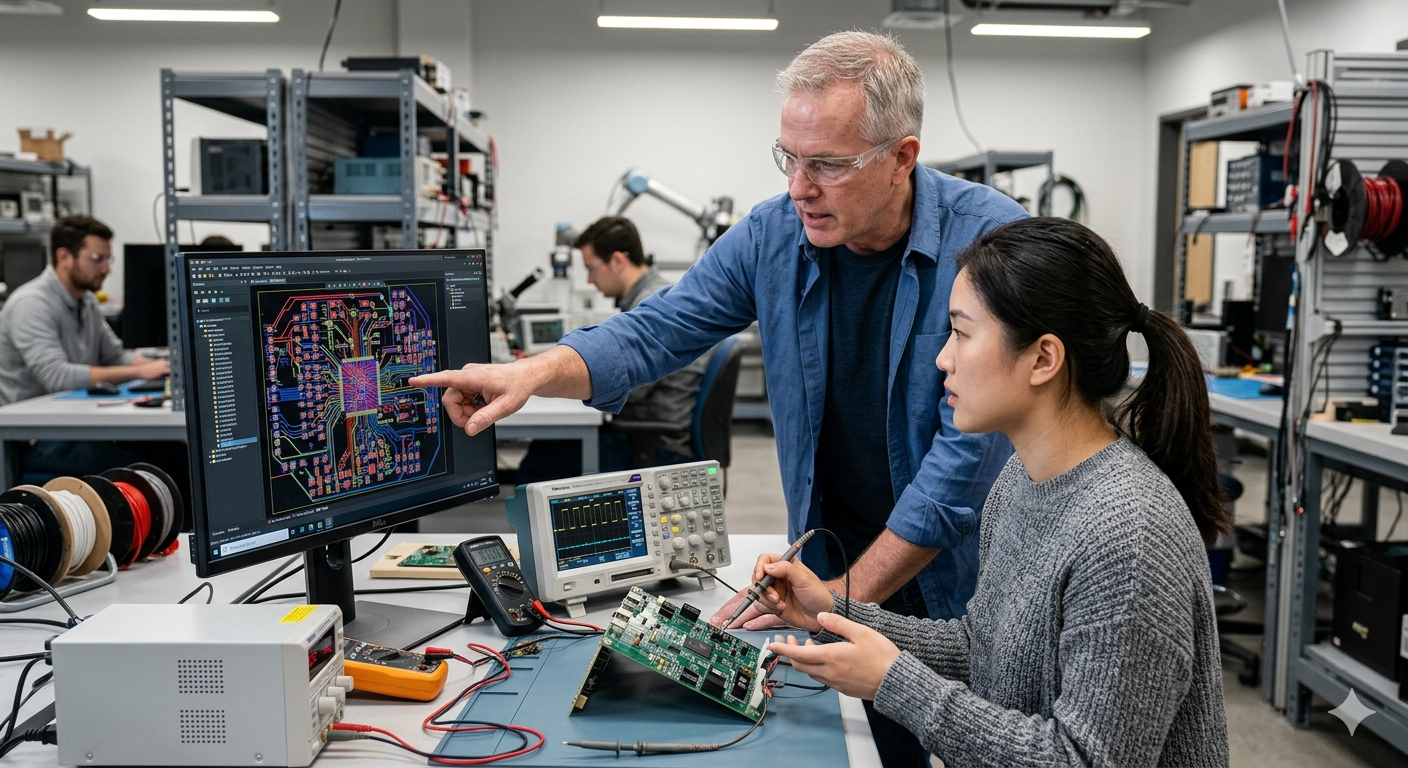
You cannot learn proper signal integrity, thermal dissipation constraints, component derating criteria, or manufacturing clearances (DFM) from a static presentation slide. These are trade skills passed down from senior engineers to juniors over real workbenches, looking at real layouts.
At MentorCrux, we built this platform because we believe top-tier engineering expertise should not be locked behind corporate silos. Our mentors are senior design engineers, power system specialists, and industrial automation architects working in top-tier companies. They don’t give you grades; they give you the exact skills, portfolio reviews, and mock interview preparations needed to clear high-stakes technical rounds.
Stop navigating your electrical engineering career path in the dark. Stop wondering if your resume will pass the screening or why you aren’t getting callbacks for the design roles you deserve.
Take Control of Your Core Career: Book a 1-on-1 Mentorship Session on MentorCrux Today
Leave a Reply