


Bio: Nitheesh is the founder of MentorCrux, an India-based mentorship platform for core engineers. His mission is to create a space where expert knowledge is accessible to all, providing the tools and insights necessary for professional growth in the core engineering sector.
Civil engineering in India is entering a transition phase in 2026. Infrastructure investment continues across highways, metro rail, industrial corridors, renewable energy, data centers, and urban development. At the same time, hiring expectations have changed. Companies no longer want graduates who only understand theory. They expect civil engineers to contribute from the first year.
This gap between education and industry is where most careers break down. Fresh graduates feel lost. Site engineers feel stuck. Many do not know how to move into design, planning, or higher responsibility roles. The result is frustration, slow growth, and career switches that could have been avoided.
This article provides a practical career roadmap for civil engineers in India. It is written for students, freshers, and early professionals who want a core engineering career and are willing to build real skills. The focus is on realistic career paths, required skills, timelines, and decisions that actually matter in the Indian market.
Why Most Civil Engineers Struggle Early
The biggest challenge is not lack of jobs. It is lack of clarity.
Most civil engineering graduates enter the job market without knowing the difference between execution, design, planning, or consulting roles. They accept the first offer they get and hope things improve later. In many cases, they do not.
Civil engineering career guidance for freshers is weak. Colleges rarely explain how careers progress in real projects. As a result, many engineers spend their early years doing repetitive tasks without learning transferable skills.
This is why civil engineering fresher jobs feel low paying and stagnant for many candidates, even though infrastructure spending is increasing.
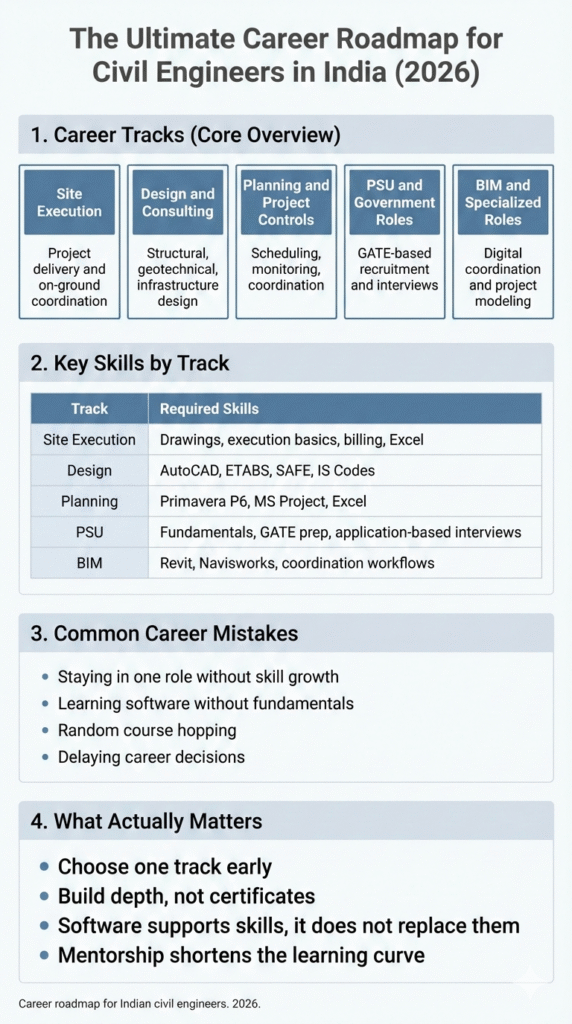
Step One: Choose a Career Track Early
Civil engineering is not one job. It is a collection of distinct career tracks. You must choose one deliberately.
In 2026, most successful civil engineers fall into one of these tracks.
- Site execution and project delivery
- Design and consulting
- Planning and project controls
- PSU and government roles
- Specialized domains such as BIM and sustainability
If you do not choose, the market will choose for you. And usually, it chooses poorly.
Track One: Site Execution and Project Leadership
Many engineers start their careers as site engineers. This role builds strong practical understanding, but only if used correctly.
The first two years should be about learning drawings, specifications, reinforcement detailing, concrete technology, quality checks, basic billing, and subcontractor coordination. If your role is limited to supervising labor, you are not growing.
Between years three and five, you should move into package ownership. This includes billing, client coordination, planning inputs, and exposure to contracts. Excel proficiency becomes critical here.
Beyond five years, strong site engineers move into project engineer or project manager roles with companies like L&T and Tata Projects.
If you are a civil engineer stuck in site job roles with no growth, the problem is usually lack of skill progression, not the site role itself.
Track Two: Design and Consulting Roles
Design roles offer long term stability and faster growth for engineers who enjoy technical work.
Core design areas include structural engineering, geotechnical engineering, transportation, and water resources. Entry into these roles requires focused preparation.
Software alone is not enough. You must understand design logic, load paths, codes, and detailing principles.
A typical civil design engineer software list in 2026 includes AutoCAD, ETABS, SAFE, STAAD, and Excel. Knowledge of Indian Standards codes is mandatory.
Many site engineers want to switch to design roles. The site engineer to design engineer roadmap usually takes one to one and a half years of structured learning and project based practice. Random courses will not work.
Track Three: Planning and Project Controls
Planning engineers are in demand across large infrastructure and industrial projects.
This role suits engineers who understand execution but prefer analytical and coordination work. Planning engineers work closely with project managers, clients, and contractors.
Key skills include Primavera P6, MS Project, Excel, and basic contract understanding. Planning engineer software skills matter more than academic background.
The site engineer to planning engineer roadmap works best when combined with real project exposure and scheduling logic, not just software knowledge.
Track Four: PSU and Government Careers
PSU jobs remain highly competitive and respected. They offer stability, structured growth, and long term benefits.
Preparation requires discipline and early commitment. You must focus on fundamentals, GATE oriented study, and structured revision.
Knowing how to prepare for PSU interview rounds is critical. Interviews now focus on application based questions, not just theory.
Many engineers fail because they treat PSU preparation casually or combine it poorly with demanding private jobs. A clear strategy matters more than effort alone.
Track Five: BIM and Specialized Roles
BIM is becoming a core requirement, not a niche skill. Large projects increasingly rely on BIM for coordination, clash detection, and planning.
Best BIM courses in India focus on real project workflows, not just software commands. Engineers with execution or design understanding benefit the most from BIM roles.
Other growing areas include sustainability, green building compliance, and project monitoring roles driven by regulatory pressure.
Software Skills That Actually Matter
One of the most common questions is which software is best for civil engineering. The answer depends on your chosen track.
For site and planning roles, AutoCAD, Excel, and Primavera are essential.
For design roles, ETABS, SAFE, STAAD, and Excel are mandatory.
For BIM roles, Revit and Navisworks matter.
Depth matters more than the number of tools. Being average at five tools is less valuable than being strong at two.
Cracking L&T and Tata Projects Interviews
Tier one EPC companies hire engineers who understand fundamentals and can explain their work clearly.
L&T interview questions for civil engineers usually focus on basics, drawings, execution logic, and problem solving scenarios.
Candidates fail because they cannot explain what they have worked on. Mock interview for L&T style roles helps identify these gaps early.
Knowing how to crack L&T or Tata Projects interviews is less about memorizing questions and more about clarity of thinking.
Salary Reality in 2026
Site job vs design job salary comparison shows mixed trends.
Early career site roles may offer slightly higher pay. Mid and long term growth favors design, planning, and project management roles.
The real risk is stagnation. Engineers who do not upgrade skills see salary growth flatten quickly.
Is MTech Worth It for Civil Engineers
Is MTech worth it for core engineers depends on the goal.
For PSU roles, research, or top design firms, a good MTech program adds value.
For engineers hoping MTech will compensate for lack of practical skills, it usually disappoints.
The Role of Mentorship
Many engineers struggle because they try to navigate careers alone.
Engineering mentorship shortens the learning curve. A civil engineering mentor India based, who understands real projects, can help engineers avoid wrong role switches and wasted years.
Mentorship for engineers is not about motivation. It is about direction, skill prioritization, and accountability.
A structured mentorship program for engineering students or early professionals provides clarity that colleges often fail to deliver.
Final Thoughts
Civil engineering in India rewards clarity, competence, and long term thinking. Engineers who grow are those who choose a direction early, build relevant skills, and understand how the industry evaluates value.
Core engineering careers are not built quickly, but they are built steadily. With the right roadmap, civil engineering offers stability, scale, and long term relevance in India.
The opportunities exist. The skills are learnable. The path is clear.
What matters now is execution.
Leave a Reply