
Let’s be honest: the core engineering dream is feeling more like a restricted secret lately.
I speak with many brilliant graduates from top-tier institutions who have mastered the Rankine cycle, can derive Euler-Bernoulli beam equations in their sleep, and hold an impressive CGPA. Yet, when they apply for a Design Engineer or Analyst role at a Fortune 100 firm, they are met with silence.
If you have the degree, why don’t you have the job?
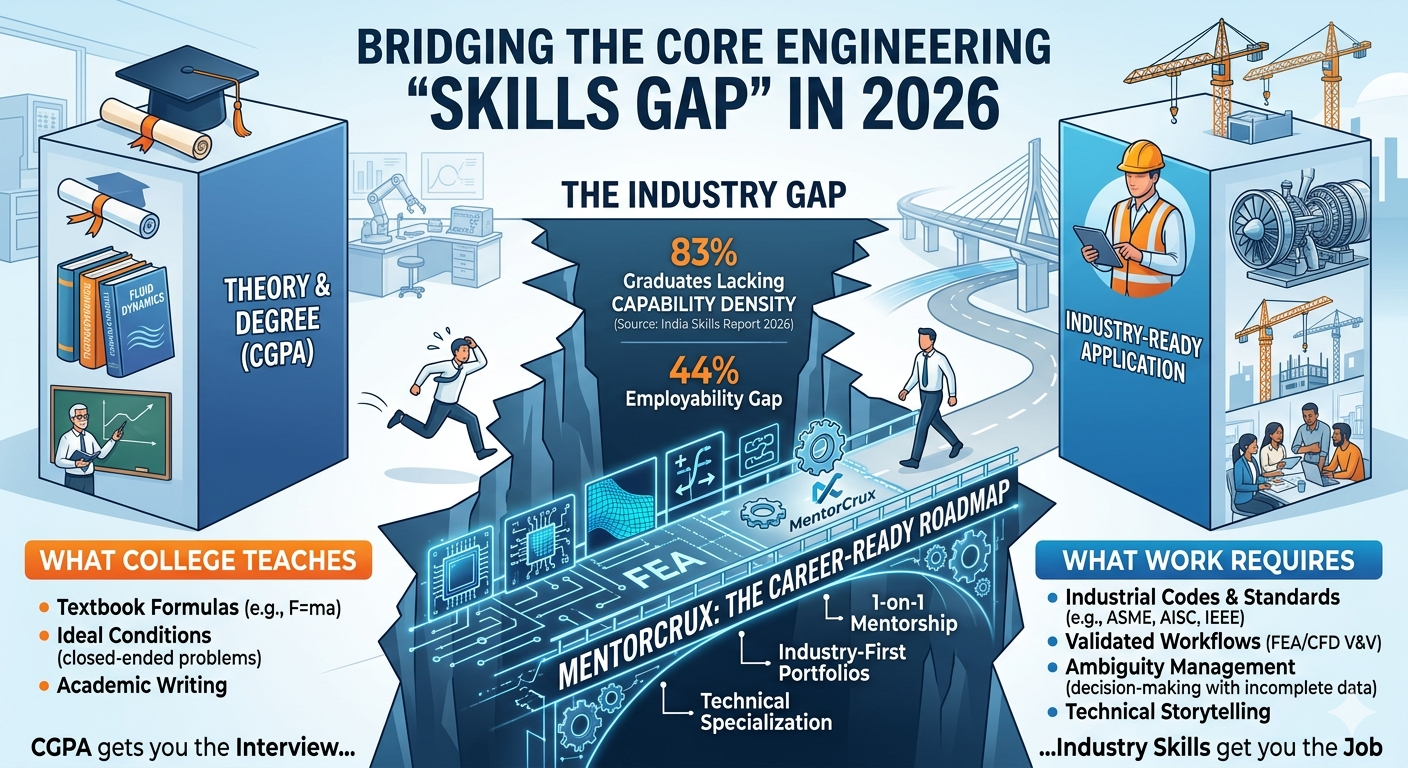
The truth is, there is a massive engineering skills gap between the university syllabus and the 2026 industrial workflow. Recent data from the India Skills Report 2026 reveals a brutal contradiction: while hiring intent is up by 73%, employability stands at just 56.35%. This means nearly half of all graduates are simply not job-ready for the roles they are applying for.
At MentorCrux, we see this daily. The industry has moved at the speed of software, while the curriculum is often stuck in the early 2000s. In this guide, I’m going to debunk the myth that a degree is enough and show you exactly how to build a profile that makes hiring managers stop scrolling.
1. The Disconnect: Theory vs. Industrial Application
In college, problems are closed-ended. You are given the forces, the material properties, and the boundary conditions. Your job is to find the single correct answer at the back of the book.
In the industry, whether you’re designing a gas turbine blade or a structural frame for an EV battery, the problem is the ambiguity. According to the World Economic Forum’s Future of Jobs Report 2025, skill gaps remain the #1 barrier to business transformation, cited by 63% of employers.
What You Know vs. What the Industry Demands:
- University Knowledge: Understanding the von Mises stress theory.
- Industry Demand: Knowing how to simplify a 500 part CAD assembly into a 10 part simulation model without losing accuracy (Geometry Idealization).
- University Knowledge: Drawing a simple part in AutoCAD.
- Industry Demand: Applying GD&T (Geometric Dimensioning and Tolerancing) so a machinist in a different country can actually build it.
Pro-Tip from the Field: If you want to impress an interviewer, stop talking about your “A” in Thermodynamics. Start talking about how you applied ASME B31.3 standards to a piping project or how you optimized an FEA portfolio to reduce computational time by 30%.
2. The 2026 Technical Stack: Beyond Knowing the Software
A common mistake students make is listing Ansys or SolidWorks as a skill. In 2026, knowing the software is the bare minimum, it’s like an accountant saying they know how to use a calculator. You need to understand the AI transformation of core engineering to stay relevant.
The Specialized Skillsets in Demand:
- CAE & FEA Specialization: It’s no longer about running a simulation. It’s about understanding Non-Linear Analysis, Fatigue Life Prediction, and Hyperelastic Materials.
- Product Lifecycle Management (PLM): Understanding how data moves from design to manufacturing via tools like Teamcenter or Windchill.
- Digital Twins & IoT: Core engineering is merging with data. Can you interpret sensor data from a physical turbine to update your FEA model? That is a 2026 skill.
3. The Hidden Language: Codes, Standards, and Documentation
If I look at a fresher’s portfolio and see a beautiful 3D render, I’m interested. But if I see a Technical Report that cites ASTM or ISO standards, I’m hiring. Real-world engineering is governed by the codes.
The ASME 2025 Annual Report highlights that over 80 countries now use the ASME Boiler & Pressure Vessel Code (BPVC). If your projects don’t reference these, they are hobbies, not engineering.
Essential Codes to Know:
- Mechanical/Piping: ASME B31.3, API 610.
- Structural: AISC 360, Eurocode 3.
- FEA Validation: ASME V&V 10.
4. The Soft Skills of a Technical Lead
At MentorCrux, we often find that the gap isn’t just technical; it’s communicative. You could have the most optimized structural analysis in the company, but if you can’t explain the risk of failure to a Project Manager who doesn’t know FEA, your work is useless.
The LinkedIn 2025 Workforce Report notes that adaptability and communication remain the most sought-after soft skills in engineering. You must master tactical roadmapping to move from a junior to a lead role.
5. Building an Industry-First Portfolio
Stop sending resumes that are just lists of subjects. You need a Technical Portfolio. High performing candidates are now using portfolio-building strategies to prove their worth.
A winning portfolio for 2026 includes:
- The Problem Statement: What real-world constraint were you solving?
- The Methodology: Which codes did you follow? Why did you choose that specific mesh size?
- The Validation: How did you check your results? (Hand calculations vs. Software).
- The Conclusion: What was the final engineering recommendation?
The Mentor’s Perspective
I’ve been where you are, sitting with a degree in hand, realizing that the real world speaks a different language. The skills gap isn’t an insult to your intelligence; it’s a failure of the system to keep pace with technology. According to McKinsey Insights, companies that embed AI and advanced modeling into workflows are 20% more efficient, and they are looking for engineers who can drive that efficiency.
But here is the good news: This gap is your greatest opportunity.
Because most graduates will continue to rely solely on their degree, the few who take the time to learn Industry Workflows, Codes/Standards, and seek Professional Mentorship will have their pick of the best roles.
Ready to bridge the gap?
Don’t let your degree be the end of your learning. If you are struggling to land that core role or don’t know which technical path is right for you, let’s talk.
Stop being just another applicant. Check out our FEA Career Launch Cohort or find your industry mentor on MentorCrux today!
Leave a Reply